
Quick Thinking Games bring a burst of energy and liveliness to your meals. They infuse the table with spark, rhythm, and playful momentum, transforming even the quietest moments into opportunities for laughter, focus, and friendly challenge. Designed to boost memory, attention, and mental agility, these games invite everyone—kids, teens, and adults—to jump in, think fast, and stay fully present in the moment.
What makes these games so appealing is their simplicity. There’s no setup, no props, no pressure—just quick calls, spontaneous answers, and the fun of racing against your own thoughts. One moment you’re calmly eating your meal, and the next you’re trying to name three animals that start with the letter “B” or searching your mind for a fruit that ends in “e.” Suddenly, the room feels alive. Minds wake up, smiles spread, and the table becomes a space where everyone is fully engaged.
These games are especially powerful because they activate the brain in joyful, accessible ways. Kids sharpen their vocabulary and memory without feeling like they’re doing anything “educational.” Teens get to use their creativity, speed, and wit in ways that feel fun rather than forced. Parents and grandparents rediscover the thrill of quick thinking and the pleasure of being mentally challenged—but in a soft, playful environment where the goal is simply to enjoy the moment together.
Picture this: someone calls out a category—“fruits!”—and suddenly everyone rushes to blurt out a different name without repeating. Or you play “Mot à mot,” where you must find a word starting with the last letter of the previous one, and the game grows faster and funnier as the round goes on. Or maybe you play “Je pars en voyage,” and each person must remember the growing list of items, leading to giggles when someone forgets the “blue balloon” or replaces it with something totally unexpected. These moments bring the whole family onto the same wavelength, thinking together, laughing together, and cheering each other on.
Quick Thinking Games also help anchor the mind in the present moment. In a world full of distractions—screens, notifications, stress—these games pull everyone back to the table, making the meal an active, shared experience rather than a passive one. You can feel the shift: the energy rises, conversations open up, and even the quietest family members begin to participate. The joy isn’t only in the answers; it’s in the togetherness these fast-paced challenges create.
Beyond the fun, these games offer real cognitive benefits. They strengthen memory, improve verbal fluency, enhance focus, and develop mental flexibility—skills that help kids in school, teens in problem-solving, and adults in daily life. But the beauty is that these benefits happen naturally, without any pressure or expectation. The playfulness makes learning effortless.
For families with different ages at the table, these games are wonderfully inclusive. Questions and categories can be adapted on the spot, making everyone feel capable and engaged. A younger child might name colors or animals, while an older sibling takes on more complex categories like countries, verbs, or mythical creatures. Everyone participates at their own level, but all share in the excitement and momentum.
And the laughter—there’s always laughter. Quick Thinking Games leave room for silly mistakes, surprising answers, and joyful reactions. Someone might accidentally repeat a word, invent one, or freeze mid-sentence. The chaos of those few seconds becomes the highlight of the meal. These little imperfections aren’t failures; they’re part of the joy. They remind everyone that fun doesn’t have to be polished or planned—it just needs a spark.
As the rounds go on, the table transforms into a lively circle of concentration and amusement. The pace might pick up, voices overlap, and you’ll feel a sense of shared energy filling the room. This lively atmosphere deepens family connection, breaks the ice on difficult days, and turns ordinary dinners into memorable, dynamic experiences.
Quick Thinking Games are more than quick challenges—they are invitations to engage, to think together, to surprise one another, and to enjoy the beauty of being mentally present with the people you love. They bring lightness, joy, and warmth to family life, reminding everyone that even the simplest moments can become meaningful when shared with energy and playfulness.
So dive in, think fast, laugh loud, and enjoy the vibrant atmosphere these little games create. One category, one word, one laugh at a time, they turn your family meals into moments that spark connection, joy, and unforgettable memories.
Quick Thinking Games
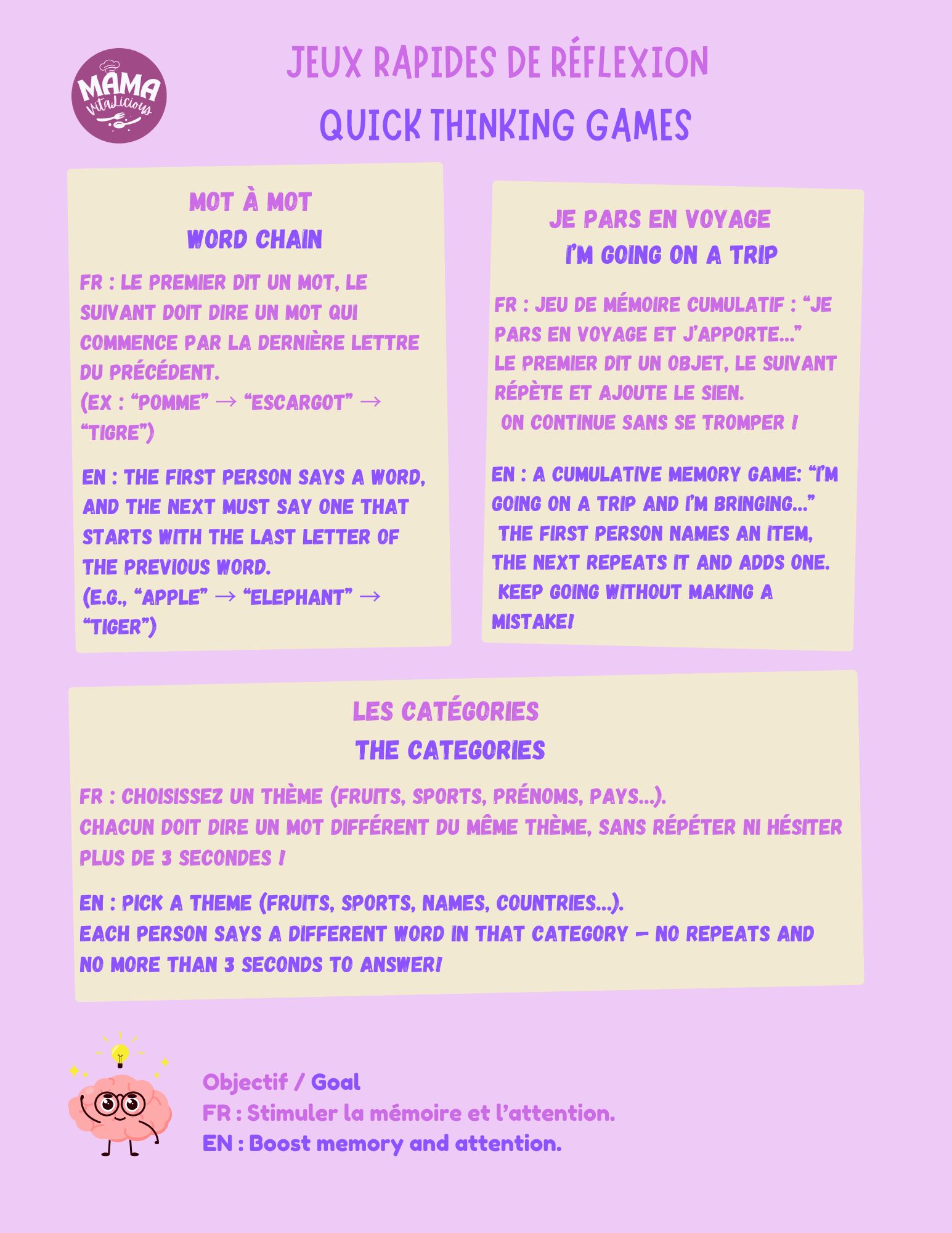
Ready to print? Click here
Other articles you may be interested in!
Gratitude & Sharing Games : Celebrate, Compliment, Connect
Conversation Games : Words that bring you together
Silly & Fun Games : Unleash your inner clown
Frequently Asked Questions
Are these games suitable for all ages?
Yes, though some games may be challenging for very young kids. You can simplify words, themes, or remove the time pressure for younger players.
Do we need a good memory or quick reflexes to play?
Not at all! The goal isn’t to perform but to have fun. These games can be adjusted to match everyone’s pace.
What if someone is blocked or hesitant?
You can give a hint, switch the theme, or simply move to the next player. The goal is to keep the atmosphere positive.
Do these games really help with concentration?
Yes! They boost memory, focus, word association speed and mental flexibility—while staying simple and fun.
Can they be used as an educational activity?
Absolutely. They build language skills, working memory, logic, and listening. Great for turning learning into something natural and fun.